For decades, retailers and brands have focused their innovation, capital, and strategic planning on forward logistics: purchasing, fulfillment, store distribution, and last-mile delivery. Meanwhile, the reverse side of the supply chain, the movement, processing, and reintegration of returned products, remained an operational afterthought.
The dynamic is changing. Reverse logistics will become a defining test of supply chain resilience, profitability, and a retailer’s ability to uphold the customer promise. This shift creates a new mandate for supply chain and logistics leadership: replace fragmented, manual returns operations with unified, automated, and data-driven processes before they erode margin, visibility, and performance. Throughout this blog, that transformation is what we mean when we refer to modern reverse logistics.
Driven by record eCommerce volumes, evolving customer expectations, marketplace expansion, and the rise of multi-channel retail, returns have become a critical lever for improving cost efficiency, inventory accuracy, and overall supply chain performance. Retailers that fail to unify returns data, automate decision-making, and orchestrate product movement across partners face growing margin pressure, inventory distortion, and operational strain.
As return volumes continue to rise, many organizations are actively evaluating reverse logistics solutions and a returns management platform that can reduce operational strain, improve inventory accuracy and value recovery, and support profitable growth across channels. Those that succeed are unlocking a new profit engine powered by visibility, automation, and intelligent routing.
The Reverse Logistics Surge Is Outpacing Operational Capacity
Online shopping has permanently reshaped return behavior. Return rates remain significantly higher for eCommerce than in-store purchases (15.8% eCommerce vs. 8.71% in-store, NRF 2025), yet the physical and digital infrastructure supporting returns has not kept pace.
The result is widespread operational stress:
- Warehouse congestion at inbound docks
- Unpredictable labor demand driven by return surges
- Long inventory delays reducing resale velocity and recovered margin
- Fragmented workflows across multiple internal teams and external partner
When returned products sit idle or move through inefficient pathways, retailers lose inventory value, slow resale velocity, and distort forecasting models. Supply chain leaders are increasingly recognizing that reverse logistics optimization is no longer optional, it is essential to reduce warehouse and labor strain from returns, recover trapped inventory value, and stabilize operations.
Fragmented Systems Are Distorting Inventory and Decision-Making
Why are returns causing inventory distortion?
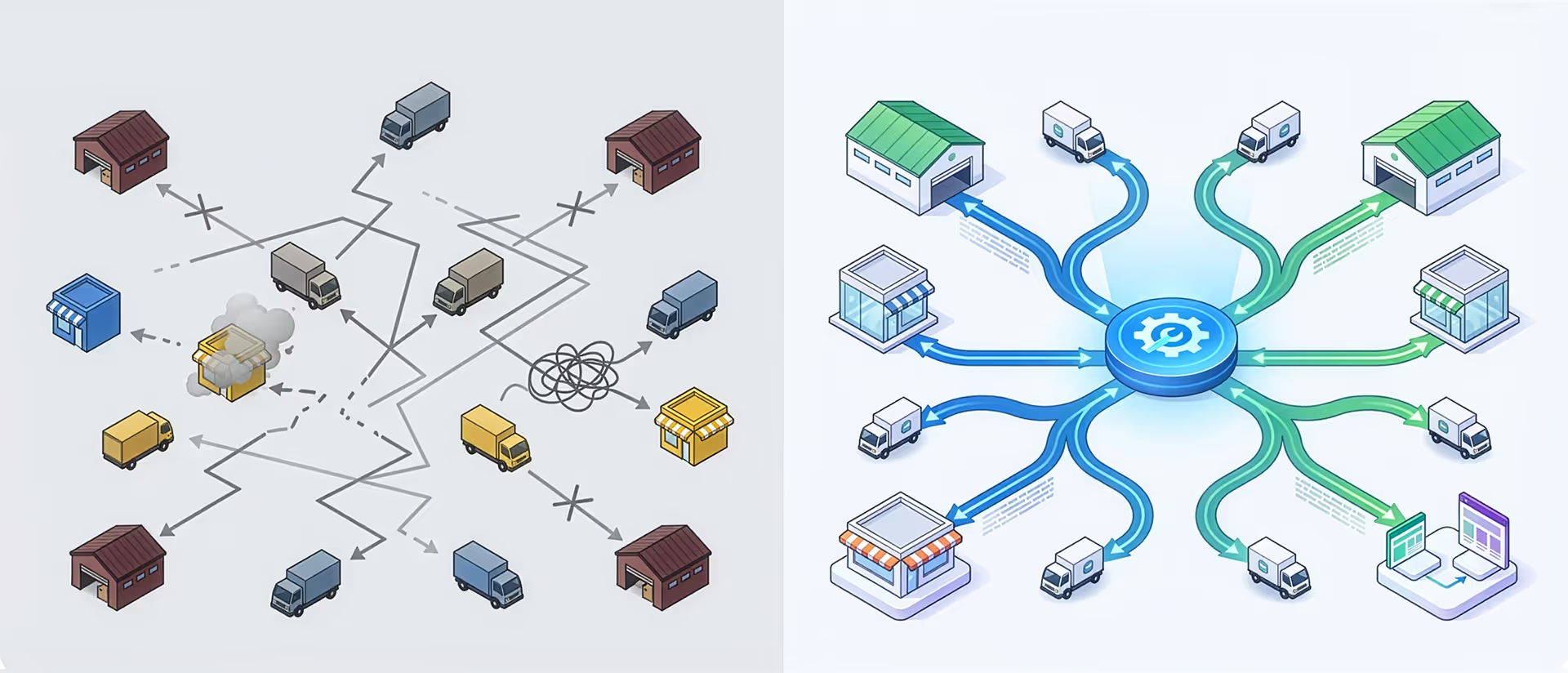
Because most retailers manage returns across disconnected systems that lack shared data, real-time visibility, and coordinated decision-making. Most organizations rely on disconnected ERP, WMS, OMS, and carrier systems that were never designed to communicate across the return lifecycle. In many cases, different stages of the return journey are outsourced to different partners, further fragmenting data and accountability.
This fragmentation creates blind spots that force teams into reactive, manual processes. The consequences are familiar:
- Returns disappear into system gaps
- Inventory forecasts become unreliable
- Vendors and partners receive inconsistent information
- Resellable products sit in limbo or are prematurely liquidated
- Decisions rely on anecdotes instead of data
Reverse logistics challenges are rarely about trucks or warehouse space. They are rooted in disconnected data and the absence of a unified control layer. Without a single source of truth for returns, retailers cannot route products effectively, accelerate turnaround time, or maximize value recovery.
Omnichannel Returns Are Overwhelming Legacy Infrastructure
Today’s retailers and brands operate across a complex network of channels, making omnichannel returns management significantly more complex than forward fulfillment:
- Direct-to-consumer
- Marketplaces
- Wholesale
- Social and livestream selling
- Store-to-store
- Ship-to-store
- Drop ship
- Distriibuted 3PL networks
Each channel introduces unique return rules, partners, and pathways, and no two returns are the same. Products come back in different conditions, at different points in the season, with varying resale windows and downstream value. A like-new item returned mid-season requires a very different path than an end-of-season return, a damaged unit, or a product coming back through a marketplace or wholesale channel. Legacy systems were never designed to account for this level of variability across channels, timing, and product state.
Reverse logistics now requires intelligent orchestration:the ability to evaluate each return in real time and route it to the optimal next destination based on condition, seasonality, demand, cost, and recovery potential, whether that destination is a warehouse, store, refurbisher, recycler, liquidation partner, or rapid restock pipeline. This level of coordination is at the core of reverse logistics orchestration, enabling a true reverse supply chain transformation rather than incremental process improvements.
Without orchestration, returns pile up, costs escalate, and inventory accuracy deteriorates. With it, retailers regain control, reduce friction, and maximize value across the network.
Returns as a Strategic Driver of Supply Chain Value
Most supply chain leaders already understand that returns carry strategic importance. What has changed is the scale of that impact and the level of operational discipline required to capture it consistently.
Forward logistics is optimized for outbound efficiency and speed. Reverse logistics is optimized for value recovery, inventory readiness, and post-purchase optimization. Retailers that elevate returns from a background function to a deliberately managed capability are seeing measurable performance gains:
1. Faster return-to-stock readiness increases recovered margin
Every day a returned item sits idle reduces its resale value. Accelerating inspection, routing, and restock readiness improves inventory recovery and limits markdown exposure.
2. ReCommerce routing unlocks higher-margin recovery paths
Established resale and recommerce channels, such as secondary marketplaces, outlet networks, and branded resale, enable retailers to recover significantly more value than liquidation. Intelligent disposition and routing ensures each return is directed to the most profitable resale channel based on condition, timing, and demand.
3. Optimized routing reduces handling, transportation, and sunk return costs
AI-driven decisioning minimizes unnecessary touches and miles, ensuring products take the most cost-effective path back into inventory, refurbishment, resale, or other downstream destinations, directly protecting margin.
4. Greater visibility reduces damage, misclassification, and unsellable inventory
A unified view of return flows minimizes misrouting and handling errors, preserving product value while improving customer satisfaction and operational confidence.
5. Accurate data strengthens vendor relationships and accountability
Consistent, transparent returns data reduces disputes, improves reconciliation, and creates clearer performance accountability across suppliers, carriers, and service partners.
When managed intentionally and supported by real-time data, reverse logistics becomes a powerful lever for inventory accuracy and value recovery, margin protection, and supply chain resilience.
How Automation and AI Are Reshaping Reverse Logistics
Leading retailers are transforming returns operations by applying automation and intelligence where manual processes once dominated:
- AI-Driven Return Routing
Machine learning evaluates cost, condition, demand, and seasonality to determine optimal next steps for each item.
- Predictive Returns Analytics
Forecasting models anticipate return volumes, labor needs, and inventory impact with far greater accuracy.
- Automated Returns Workflows
Automation removes manual handoffs, exception handling, and inconsistent decision-making.
- A Unified Returns Data Foundation
Centralized data replaces siloed systems, spreadsheets, and email-based processes.
Together, these capabilities form the foundation of a modern returns management platform that replaces manual workflows with automated, data-driven control. These capabilities don’t simply improve efficiency, they rebuild the reverse logistics infrastructure to scale reliably as volumes and channels continue to grow.
Orchestrated Reverse Logistics Will Separate Leaders from Followers
The gap between retail supply chain leaders and followers is no longer theoretical, it is operational, financial, and increasingly visible in day-to-day performance.
How can supply chain leaders turn returns into a profit center?
By orchestrating reverse logistics with automation, unified data, and intelligent routing rather than treating returns as a disconnected cost function. Retailers that continue to manage returns as a manual, fragmented cost center face compounding challenges: rising labor volatility, constrained warehouse capacity, delayed inventory recovery, and margin erosion driven by misrouting and slow decision-making. At scale, these limitations don’t just reduce efficiency, they limit resilience and profitability.
In contrast, retailers that treat reverse logistics as a strategically orchestrated value stream are building a measurable advantage. By automating routing decisions, maintaining real-time visibility across partners and channels, and unifying returns data, they shorten cash conversion cycles, protect margin, and restore predictability to inventory and labor planning.
The difference isn’t network size or return volume, it’s control. As return complexity accelerates, that control will determine who scales profitably and who absorbs rising cost and risk.
Reverse Logistics Completes the Supply Chain Loop
The supply chain of the future will not be defined by how fast products move outbound alone, but by how effectively retailers manage product movement, data, and value across the entire lifecycle. Reverse logistics closes that loop. It connects customer behavior, inventory readiness, and operational execution into a single, continuous flow.
When retailers replace fragmented returns processes with unified orchestration and automation, they unlock tangible gains:
- Faster inventory recovery
- More predictable customer experiences
- Lower operational and transportation costs
- Improved sustainability outcomes
- Stronger partner accountability
- Reclaimed margin and financial performance
Reverse logistics is no longer a peripheral function. It is the final link that turns supply chain complexity into competitive advantage.
Ready to Turn Reverse Logistics into a Strategic Advantage?
For supply chain leaders focused on resilience, efficiency, and profitability, orchestrated reverse logistics is the next major unlock. ReturnPro delivers reverse logistics solutions that help retailers manage returns across every channel, partner, and system, bringing clarity to complexity and control to chaos.


.avif)